Sunday, April 3, 2016

Imagining the Moon: Moon Landing Fictional Non-Fiction

You Will Go To The Moon by Mae and Ira Freeman.
Illustrated by Robert Patterson. Beginner Books Inc. 1959. 


 I wonder if there was a first human to look up into a moonlit night sky and wonder what it would be like to walk upon the faraway moon.

I can't help but feel that it had to have been a child.

I happened upon this children's book wedged into an overcrowded bottom shelf at Half Priced Books (which is quickly becoming one of my favorite book haunts).   It was an easy book to overlook--the spine is an unremarkable brown with white block letters spelling out the equally unremarkable title.  

But I slid it out anyway, and I am so glad that I did.

This book feels like a non-fiction book.   Easy vocabulary aimed at a 1st or 2nd grade reading level.   Specific scientific vocabulary such as "gravity", "centrifugal force" and "inertia" are discussed  in the text and then defined and described in detail in a brief, simply written glossary in back.

And perhaps in 1959 this was considered a non-fiction book of sorts--a scientific inspiration-sparker for young starry eyed someday astronauts designed to whet their whistles for the future of space travel.


But reading it now in 2016, 57 years after it was written and 47 years after the first actual moon landing, it seems almost campy--like a written version of early science fiction TV dramas.

Clearly the seeds for the actual moon landing in 1969 had been planted and informed by the Russian space endeavors, starting with the first ever earth orbiting satellite Sputnik 1 in 1957. (1).  This was followed closely by Sputnik 2 which sent the first living creature into orbit--a dog named "Laika". (1)

The gauntlet had been thrown down and the race was on between the USSR and the United States--who would get to the moon first?

Vostok 1 (4)


By 1961 the Russians had sent the first human (Yuri Gagarin) into orbit around the earth.(1)   Gagarin's spacecraft--named "Vostok 1", did not resemble the sleek rockets dreamed up by science fiction writers or even forward-thinking scientists. But the fuel for dreams was there--and I can't help but feel that images of these early Russian spacecraft fueled the illustrations for this book, at least in part.  And since the concept of multi-stage rockets has been around since between 1300-1350 AD in China (5),  both the authors Mae and Ira Freeman, and illustrator Robert Patterson must have had ample source material upon which to base the story and drawings.

But this book was written and published before Yuri Gagarin made his historic trip into orbit--and it shows.

Authors Mae and Ira Freeman must have been aware of where this book would stand--straddling science fiction and science fact.   To bridge this, they wrote the book in second-person future tense.  It reads like a narrator directing you through your particularly detailed and realistic dream and is reflected in the title You Will Go To The Moon.  


Take for example how space travel is depicted in the illustrations--the young main character and the "rocket man" (as he is called in the book) are shown wearing regular clothes, reclining in modified airline seats.


Also note the presence of a space station--depicted in the book as a kind of roadside rest stop at the halfway point between earth and moon.


*Please notice the obvious lack of women in space.  In fact the only woman
shown in this book is the boy's mother (accompanied by his father)
as they walk the boy to the rocket to see him off on his trip to the moon.

*Also space travel is not only devoid of  women, but also of any kind of
diversity.   Space travel in 1959 was evidently imagined as being solely
a "white guy" thing.   This makes me crazy.


In this space station, the young space traveler and his "rocket man" friend are able to enjoy various types of recreation while they wait for their "moon ship" which will take them the rest of the way to the moon.

The glossary  handily provides scientific definitions of "gravity" and "centrifugal force" to explain the presence of gravity on the space station.


The moon ship is shown as a 2-story vehicle encased in a dome of clear glass.

The text goes on to describe the three-day trip between the space station and the moon as a kind of weightless vacation in a space-age rec room replete with a tv showing a baseball game broadcast from earth, floating books to read, a magnetic chess set and various refreshments to enjoy.


Finally, one of the last pages in the book shows a "moon house", where evidently people will be able to live once they reach the moon.


When I read this book I ended up feeing rather wistful.  Once upon the time the idea of scientific endeavor and space exploration fired our imaginations and even built bridges between nations--shaky and perhaps short-lived bridges, yes, but bridges nonetheless--as we collectively tried to expand our understanding of the universe.

Now, in 2016, it seems that we humans have lost a lot of our curious spark, and have drawn away from imagining any kind of future except the kind we can peek at on the tiny screens we hold in our hands.


I admit my cynicism.

However I do take comfort in imagining the child who once owned this book.

Maybe a little boy or girl ("Ebward"?  "E.B. Ward"?) who read this book with a parent or a grandparent or a teacher and dreamed of going to the moon and living in a "moon house".

Maybe a little boy or girl who grew up and lived up to these dreams.

Who knows?


Sources

1. http://www.historytoday.com/richard-cavendish/soviet-union-first-moon

2. https://en.wikipedia.org/wiki/Apollo_11

3. http://ezinearticles.com/?Critique-Of-Ira-M-Freemans-Book:-All-About-The-Atom&id=6123395

4. http://eandt.theiet.org/magazine/2011/03/yuri-gagarin.cfm

5. https://en.wikipedia.org/wiki/Multistage_rocket#History_and_development

Friday, April 1, 2016

Pampeliška (Dandelion)


Dandelion by Ladislav Svatos. Doubleday & Company, Inc. 1976.


Finding a splendid vintage book with a complex history is so very satisfying when achieved in a bookstore.   However finding a splendid vintage book is infinitely MORE satisfying when you stumble upon it.

And when it comes to stumbling upon books,  I will blushingly suggest that I am a fantastic klutz.

I stumbled upon this treasure-- Dandelion by Czechoslovakian artist and writer Ladislav Svatos--in a Goodwill store in Wheaton, Illinois.

This particular Goodwill store has become one of my favorites.  Thrift stores depend on donations, and this particular Goodwill store seems to be fed a rich diet of library castoffs, attic evacuations and downsizing diamonds in the rough.

Much to my dysfunctional delight.

Finding out more about author Ladislav Svatos proved to be as eye-opening as it was challenging--primarily because most of the information about Svatos is in Czech.  And unfortunately I cannot read Czech.  However I AM quite skilled at plugging  Czech words into translator internet search engines.

And so I did.

Even with the inevitable garble of trying to read computer-translated Czech,  I immediately sensed that Ladislav Svatos was a man with a story to tell.
Ladislav Svatos (2)

Ladislav Svatos was born in 1929 in the Czech Republic. (2)  I wasn't able to dig up much on his early years, mostly I suspect because I cannot read Czech and thus cannot hopscotch between Czech-langauge websites to follow clues and hints as I do in English.

But I was able to uncover one bit of information on a Czech website that seems to be dedicated to former Czech political prisoners of the communist regime. (1)  This regime stretched from 1948 to 1989. (3)  Under this regime, those individuals deemed "dissidents"--including members of the Catholic church of which Svatos was a member (1)-- were removed from society. (3)

According to this website, in 1951 Svatos and a fellow church member were accused of being "agents of the Vatican" and were sentenced to imprisonment. (1)  Svatos was sentenced to 12 years imprisonment, while the other man was sentenced to 24 years. (1)

After being released from prison Svatos went on to have a family and to become a well-known designer and graphic artist (1), evidence of which I hold in my hands in the form of Dandelion.


The book Dandelion itself is visual poetry.   The stark black ink drawings on white with just touches of yellow and green  are graceful and  perfectly complement the clean botanical descriptions of the life of a dandelion.

As I read through this book several times, I was strongly reminded of Japanese ink drawings, where the simple elegance of black ink designs on white paper tells a story as much in what ISN'T there as what IS.

The empty spaces are nearly as beautiful as the illustrations.


At times, in fact, there seems to be hidden qualities in some of the drawings.  Take, for example, the drawing below of a dandelion sprout just starting to take root.  The shape of the root itself seems to take the form of a tiny human body, arms outstretched.


Similarly, in one of the last illustrations in the book, of a fully white dandelion flower just starting to release its seeds to the wind, there is something expressive in the way the dandelion is posed--almost like it is standing, tiny green hands perched on hips.  The releasing seed parachutes almost look like tiny outstretched hands.


Dandelion is a beautiful book, melding plant science and poetry in nearly perfect balance.   It celebrates one of the most ubiquitous and humble flowers--a plant that is usually uprooted as a troublesome weed and seldom held up for its simple beauty and usefulness (dandelions have traditionally been used as  food as well as to help treat various disorders). (4)

As far as I can find, while Svatos' work can be seen in various other areas, such as on book cover art, postcards and  in illustrations, Dandelion may have been his only children's book.

I find myself wishing this were not so.


Sources

1. http://www.kpv-praha15.wz.cz/kpv_SOVF_clanek51.htm

2. http://www.isabart.org/person/4129

3. https://en.wikipedia.org/wiki/History_of_Czechoslovakia_(1948%E2%80%9389)

4. http://www.motherearthnews.com/real-food/benefits-of-dandelion-greens-zmaz08amzmcc.aspx


Tuesday, March 22, 2016

The Subjectively Objective World of the Encyclopedia

Children's encyclopedias seem to me a curious thing.  Even as a child I approached children's encyclopedias with suspicion--how could one book, or even a collection of 8, 10, 12 books or more, possibly begin to explain everything in  the world?

The children's encyclopedia that is now open before me is one I cannot take credit for finding.  It was a gift from a dear, book-loving friend who is well acquainted with  my passion for vintage children's books.

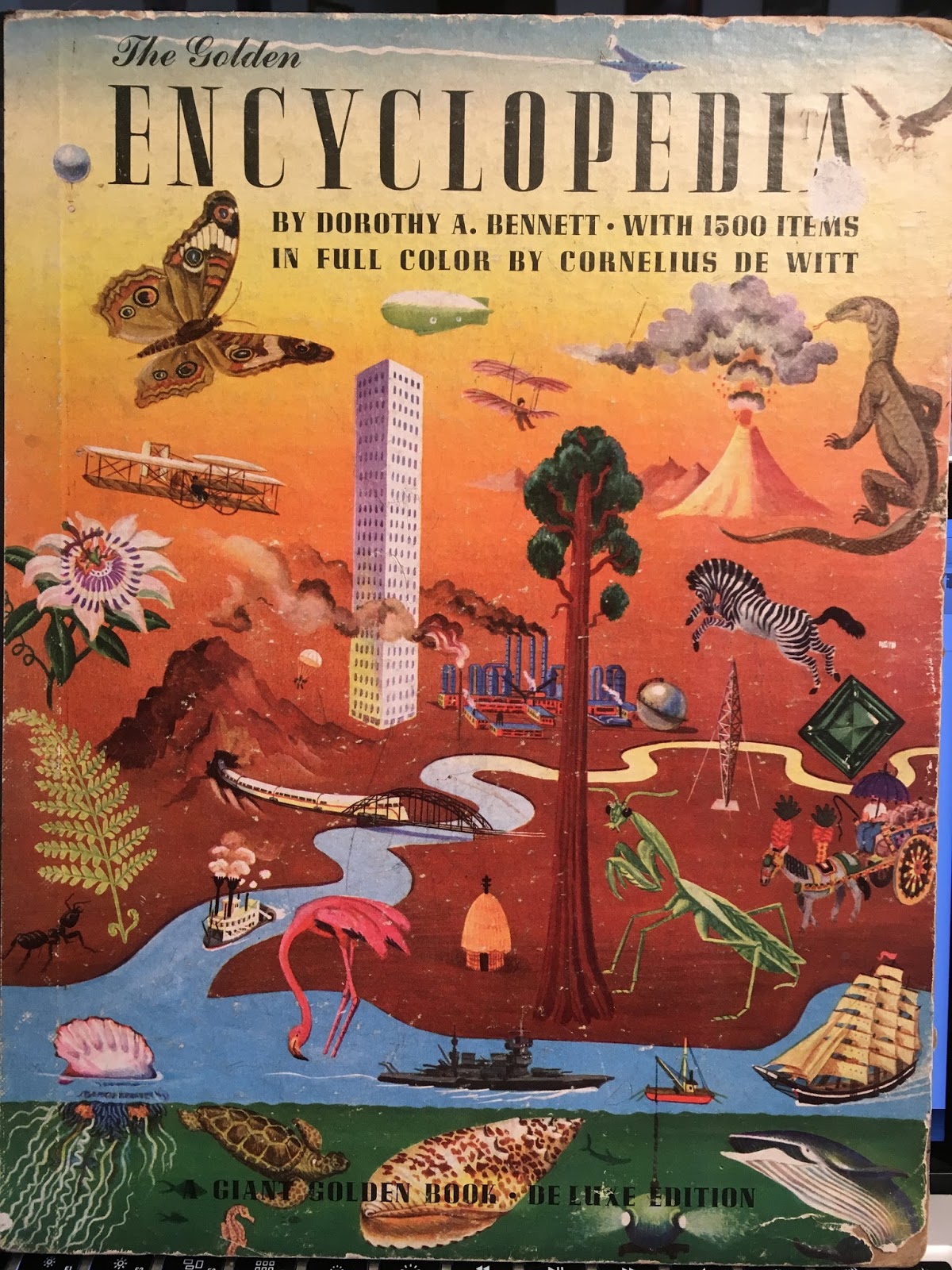
The Golden Encyclopedia.  Dorothy A Bennet.
Illustrated by Cornelius De Witt.
Simon and Schuster.  New York. 1946.
The Golden Encyclopedia was an expansion of Little Golden Books--a series of children's books conceived by George Duplaix, Lucy Sprague Mitchell and Lucille Ogle to be low-cost and using a new color technique. (1)  Bennett joined Duplaix, Mitchell and Ogle in 1943 and soon became instrumental in both authoring as well as editing Little Golden Books and Golden Books. (1)

But let's back up a bit, back to focus on Dorothy Bennett.  Unlike so many authors/illustrators of books I explore on this blog, Dorothy Bennet was not an author who published then vanished.  Far from it!  Dorothy Bennet was a renaissance woman who graduated from the University of Minnesota (and from the grasp of her over-protective parents) and pointed herself firmly towards adventure. (1)  Among her many achievements--beyond authoring--she served as an astronomer, anthropologist, was a radio personality, and was deeply involved in science education, often taking "junior astronomers" on camping trips to see stellar phenomena (1).

Needless to say, I could go on and on, but I won't (although I highly recommend you read her Minnesota Alumni bio listed below!)


So Dorothy Bennett knew her stuff.   However, she knew her stuff in the mid 1940's.   Which brings me back to my long-standing suspicion of children's encyclopedias.   Anything written by humans is biased, subjective and irrevocably stamped by time.  True objectivity, in my experience, is rare, if not nigh on impossible.  So as amazing as Dorothy Bennett was,  this encyclopedia is most certainly a product of its time.

Take for example the section on "Man".  In the mid 1940's, science classified people into watercolor boxes of skin tone.  We would rightfully consider this to be offensive  nonsense today (although vestiges of this classification certainly remain today in discussions of race--if we have moved beyond referring to people in terms of yellow or red skin, why do we still use "black" and "white"?  I have been asked this endlessly by my young students over the past 25 years and I have not yet found a satisfying answer.  But I digress.).  

However, in reading this section, I could tell that Ms. Bennett did work hard to present as balanced and scientific an explanation of racial differences as she could based on her background in anthropology.   I would argue that her  efforts in fact created their own subjectivity--for the mid 1940's, perhaps not everyone would've necessarily agreed with  her efforts to present  matter-of-fact, fairly reasonable-sounding information.

As I read this encyclopedia now, in 2016, I can easily point out the dated information--and at times flaws-- in Dorothy Bennett's descriptions.  However throughout the book Ms. Bennett's inner scientist shines through.  Her descriptions resonate as well-crafted lectures, enhanced and embellished by the intricate illustrations.

Which brings us to the illustrator, Cornelius De Witt.   Unlike Dorothy Bennett, Mr. De Witt IS something of an enigma.   


While the internet is replete with samples of his work, finding information about the man himself is nigh on impossible.  I could only find the most basic of information.  Cornelius De Witt was born in 1905 in Germany and passed away in 1995 in Massachusetts. (2)   However, where the man may have become inaccessible, his work lives on, and anyone who grew up in the United States Between 1940 up to the 1980's has most certainly run across Mr. De Witt's brilliantly colored and fascinatingly detailed illustrations.

When my friend handed me this book I ran adoring fingers over the brilliant colors and details on the cover, examined the binding and carefully opened it to the title page.  Then I did what I always do with vintage books:   I held it loosely in my hands and just let it fall open.

Most of the time these vintage books simply open to reveal text and illustrations for me to examine.   But once in a while the book will open up to reveal a hidden, long-forgotten treasure.

Such is the case with this encyclopedia.  When I first let it fall open, tucked into the "N" section was this paper:


It was an abandoned World History assignment, completed by a student in 1957.   My brain of course kicked into a heap of questions:  Who was this student?   What grade was he in?  The subject area would seem to point to a junior or senior high student.  If so, was this book once in his classroom or in the library?  Or was it a book he found laying around his house and he simply referred to it so he could  get his assignment done as quickly as possible?

Perhaps the most endearing part of finding this paper is that it reminded me of the assignments my own son tried to rush through when he was younger--the handwriting crammed together, the answers given in fast-forward bits instead of complete sentences.

And this is the essence of my love for vintage books.  Biased, dated, subjective, even sometimes offensive as they may sometimes be, they remind me where we used to be and where I used to be, and inspire me to keep looking forward, even as I peek back.


Sources

1. http://www.minnesotaalumni.org/s/1118/social.aspx?sid=1118&gid=1&pgid=3685&cid=5996&ecid=5996&crid=0&calpgid=3654&calcid=5955

2. http://www.askart.com/artist_keywords/artist/24291/artist.aspx


Saturday, February 27, 2016

Once Upon a Mother Goose: The Elusive Ms. Madge A. Bigham

Stories of Mother Goose Village. Madge Alford Bigham.
Rand, McNally & Company. 1927. 


Once again, as I bumble my book-lousy way through the endless quantities of old books (or what I consider endless, for practical purposes), I have stumbled on a person who seems to have been erased from history.

Not removed.

Not hidden precisely, but erased--erased in such a way that you have to look really hard at where she used to be in order to find her again.

Like when you erase something you wrote in pencil, but can still just manage to see the ghostly imprint of your words, still pressed into the paper long after the graphite has been rubbed away.

Madge Alford Bigham is one of these erased people.

Madge was born in LaGrange, Georgia in 1874. (2)  She was one of  ultimately 12 children of Rev. Robert William Bigham--Madge and her 7 brothers and sisters by their mother Charlotte, and then later joined by 4 younger siblings by their father and his second wife. (2)

This is pretty much the extent of what I could find out about Madge's early life, and the sources I was able to uncover pretty much all agreed--very little is known now about Madge Bigham.   I can't help but find this lack of information frustrating, for I always wonder how people's childhoods impact their adult choices.  This, I find, is especially true when I consider Madge.

By the age of 22 she had graduated from the Georgia Women's College, and within 5 or 6 years had become principal of the Atlanta Free Kindergarten--one of the first kindergartens in the United States. (2) From what I could piece together, this Kindergarten was likely located in an attached area in her own house, which she shared with her brother and 2 sisters--all of whom never married. (1) (2).

However Madge was not only a groundbreaking  educator,  introducing the Atlanta area to the concept of kindergarten programs.  Madge also followed in her father's publishing footsteps as a talented and savvy author in her own right. (2)

Which brings us to this book, Stories of Mother Goose Village, first published in 1903.

 This is not just another collection of Mother Goose rhymes, although Madge includes a pleasingly complete collection of Mother Goose rhymes in the back of the book.

This book most closely resembles a kind of text book, or skills book primarily focused on basic math skills and reading comprehension.  The entirety of it is couched in a surprisingly delightful storyline where the characters from Mother Goose rhymes and poems all live in Mother Goose Village.  The skills and/or lessons in the book are then couched in various stories involving these characters.

That Madge was a teacher and principal is obvious when one turns to the back of the book where she has added a section specifically for teachers that offers a brief summary of each chapter and skills objectives.


Ordinal numbers, sequential thinking and creating lists


Numbers, symmetry, geometry--using an activity that is still in use today


As so often happens when I start digging around in old books, I stumbled on a lovely small epiphany.  Most Early Childhood and Kindergarten teachers today are familiar with the apple-based story of the "The Little House with No Doors and No Windows and a Star Inside".  Many teachers bring out this story in various forms and levels of complexity during autumn months, when apples are seasonally plentiful.   In this story, the apple is the house, and when you slice the apple open horizontally, you find the seeds in their little pods in the shape of a 5 pointed star.   Usually this story is attributed to "unknown".
(2)


Not any more.

This story originally comes from none other than Madge Alford Bigham, in her book Overheard in Fairyland (1914).(2)   When I think of all the years I taught young children, and used this story, never knowing who first cut open an apple one day and saw, not a snack, but a story.

Which also reminds me of my original wistful consideration of how people get erased. Some, like Madge, get erased, but incompletely, so that a determined enough person could find her.

 Other people get erased from our collective consciousness so completely that no amount of determination could bring them to light.

(2)

Perhaps, in the end, our "nows" are as much eternity as we can hope for.


Sources

1.http://tomitronics.com/old_buildings/hammonds%20house/index.html

2. https://adventuresincemeteryhopping.wordpress.com/2013/10/25/madge-bigham-unearthing-an-atlanta-treasure/