Showing posts with label Racial/Ethnic Bias. Show all posts

Saturday, August 13, 2016

ぞうのホートンひとだすけ (Horton Hears a Who)


(3)


Last week I was once again huddled on the floor in the vintage books  corner of "Half Price Books".

My eye caught sight of a familiar orange-spined children's book.   The corners of the front and back cover were predictably soft and rounded.  Inside on the front end paper a name was printed in bold, decidedly adult handwriting and a large, faint ball point "X" had been scrawled across the smiling elephant face on the front cover.  I got a strong, happy vibe that this may have once been a teacher's book.

Aside from these signs of age, the book was in very good condition.  I levered myself off the floor and sat in a chair, "Horton Hears a Who" gently cradled in my arm.

"Horton Hears a Who!", written and illustrated  by Dr. Seuss (Theodor Geisel)  is just one of Dr. Seuss'  many iconic, instantly-recognizable and, indeed, universally beloved creations.  Dr. Seuss' works have been translated into over 20 languages (2) including, of course, Japanese.

And yes, there is a reason I am fixating on Japanese.

(3)
I looked at the copyright date inside the front page--the year "1954" hovered  near the bottom. Not quite trusting that I was holding a first edition book, I pulled out my iphone and after about 15 minutes of poking at the tiny screen, I ascertained I was indeed holding perhaps a 1965  or 1966 edition, based on the back cover details and the fact that the list  Other Books by Dr. Seuss in the front of the book ended with two books published in 1965: "I had Trouble Getting to Solla Sollew" and "Fox in Socks" (10).

 As a student I must have read this book--or had it read to me--countless times.  As a Early Childhood/Kindergarten teacher I must have read it aloud to students a hundred times more--at least--over my 25 years as a teacher.  I recognized each picture. I recalled each turn of phrase.


(3)
But there was one thing I did not recall noticing.  Not once.

The dedication.

"For My Great Friend,
Mitsugi Nakamura
of Kyoto,
Japan."


How was it that I had never noticed this before?  I lived for coincidences like this.  I had lived in Japan for 8 1/2 years--5 of those years in Kyoto.  And here was a detail in a beloved children's book just screaming coincidence.  Even more perplexing was the fact that I always, ALWAYS pointed out the dedications in the books I read aloud to my students.  Doing so not only brought us closer to seeing the author as a real person, but sometimes also planted a tiny seed in many students about who THEY would dedicate a book to, if THEY were to write a book.

So how did I miss THIS dedication?


Before I could try to discover the identity of Mitsugi Nakamura I had to step back a bit, before "Horton Hears a Who!" was written, back to World War II. Back to the years 1940 to 1948, when Theodor Geisel was the chief editorial cartoonist for the New York newspaper PM. (4)

(8)
Throughout World War II Theodor Geisel turned his talents, not to writing and illustrating whimsical tales of cats and elephants, but to creating scathing political cartoons and newsreels  that caricatured and demonized those people and countries against whom the United States was fighting in the war--namely Germany and Japan.(5)   While many sources I could find described Geisel as a supporter of civil rights, women's issues and labor unions (5, 6), at the same time he was creating anti-German and anti-Japanese political cartoons which he considered to be part of the defense of his country in wartime. (4)  He, like so many other Americans, felt it was his patriotic duty to stand against Germany and Japan--a duty carried out as much through  his art  as through his 1943 enlistment in the Army as part of Frank Capra's Signal Corps unit.(4,8,11)


So if Theodor Geisel was so anti-Japanese, how is it that he dedicated  "Horton Hears a Who!"  to his "...Great Friend, Mitsugi Nakamura, of Kyoto, Japan"(1)?

Simple.  He went to Japan.

On March 23rd 1953 Theodor Geisel visited Kyoto, Osaka and Kobe Japan (4,7,8).    He went there on assignment by the Ford Foundation to investigate the effects of World War II upon children and to ascertain the effects of the American occupation. (8) Geisel's friend from Dartmouth, Professor Donald Bartlett, arranged for him to meet with teachers in each city, who then had their students draw pictures to give Geisel of what they hoped to become in the future. (8)

I don't think it is too much of an exaggeration to say that his trip to Japan was life changing.

It is as true now as it always has been:  it is much harder to demonize people once you get to know them. Once you see the world through their eyes.

It was during that trip that Professor Bartlett  introduced Geisel to  Mitsugi Nakamura, who was then Dean of Doshisha University in Kyoto. (8)

According to sources I could find, a close and lasting friendship grew between Geisel and Nakamura-san, with multiple trips made to visit each other over the years and Nakamura-san's daughter even being sponsored by Geisel and his wife to attend college in California. (8)

Geisel's trip to Japan ultimately fueled his desire to write "Horton Hears a Who!"--a book that
has been interpreted to represent Geisel's desire to offer protection and guidance to Japan as they tried to heal from the war, and more specifically, from the bombs that the U.S. dropped on Hiroshima and Nagasaki. (12)  Across all the articles I read, there was a general consensus that "Horton Hears a Who!" was written as both an apology of sorts for Geisel's earlier, war-tainted views against the Japanese people, as well as a cautionary tale for all of us, countries, governments and individuals alike.

In the course of researching for this post, I came across many academic papers, opinion pieces and blogs that asked multiple versions of the same questions:  How can we reconcile that Dr. Seuss, creator of so many powerful, beloved children's books, was the same man who once drew such painful, racist and dangerous political cartoons? And can we forgive him?

This is perhaps a question wrongly put.

It is not for us to forgive.   Theodor Geisel chose to re-evaluate his beliefs rather than allow himself to stagnate in his former fear and hatred of former enemies.  He kept growing, not towards perfection (a human impossibility), but towards greater understanding.

"Horton Hears a Who!" may have been partly written as an apology. However as I re-read it now, it seems instead to  reflect Geisel's attempt to share the lessons he learned, perhaps with an eye towards building a better future.

The question  is not "Can we forgive him?" but rather "What can we learn from him?"

As it turns out, we can learn perhaps a great deal, and not just through his words and pictures.


Sources

1. http://www.ebay.ie/itm/Horton-Hears-a-Who-Japanese-Edition-Dr-Seuss-/162150032379?hash=item25c0e523fb:g:kn8AAOSwTZ1XmMHG

2. https://en.wikipedia.org/wiki/Dr._Seuss

3. "Horton Hears a Who"  Dr. Seuss.  Random House. New  York.  1955.

4. http://www.openculture.com/2014/08/dr-seuss-draws-racist-anti-japanese-cartoons-during-ww-ii.html

5. http://www.history.com/news/when-dr-seuss-went-to-war

6. http://www.truth-out.org/news/item/14765-radical-reading-the-progressive-dr-seuss

7. https://derwombat.net/2015/08/06/after-visiting-hiroshima-dr-seuss-atones-with-a-book/

8. http://www.drseussart.com/horton-60/

9. http://1stedition.net/blog/2007/01/horton_hears_a_who_1954.html

10. http://www.best-books-for-kids.com/list-of-dr-seuss-books.html

11. http://masshumanities.org/about/news/f04-pds/

12. https://seussblog.wordpress.com/tag/dr-seuss/page/7/

Saturday, July 2, 2016

Troubling Tales of Children of Other Lands

And lo last week  I found myself at one of my  favorite bookstores, "Bookends and Beginnings" in Evanston, Illinois.

So of course I bought some books, including this intriguing tome--"Children of Other Lands".

(1)
This was no pristine collectors item...which only intrigued me more.  Published in 1933, this copy of "Children of Other Lands" had clearly been a hands-on book.  Nearly every page includes what seem to be determined graffiti by a child--from the pencil scribbles on  the cover to the random additions of orange crayon on nearly every illustration.   Pages are ripped and the once sturdy red binding is feathering.

 I didn't have to look far to find the identity of the child.  He proudly wrote his name 3 separate times on the end papers:  Herbert Benjamin Nechin.

At first I wasn't sure how I felt about little Herbert embellishing such a lovely book--did the book bore him and he felt he had no alternative but to turn it into a coloring book?  Or did he love the book so much that it was his go-to resource for artistic inspiration?

Hard to say.


After reading this book, however, I found myself hoping that Herbert was expressing his distaste for the text, rather than sharing his approval.

The book is divided into twelve separate stories that tell the tales of representative children from lands around the globe.
(1)

Each story gives an overview of the specific country including geography, transportation, boats, customs and a smattering of history.  Individual children from that country are then described in terms of dress, food, entertainment and personality.

I can't put my finger on what precisely makes my skin crawl about these descriptions.    While I can forgive some of the ignorance of global cultures indicative of the 1920's and 1930's, I'm not sure I can so easily let go of the patronizing comments and rhetorical questions, such as in the second story about Japan, where the author points out about the Japanese people "Their skin is not white like yours, but light yellow.  Like the Chinese, they belong to the Yellow Race. Their eyes do not open as widely as yours, which makes them appear to be slanting."  And at the end of the story "How hard it is to say sayonara, which means good-bye in Japanese, to such an interesting country as Japan and to such pleasant little companions as slant-eyed Togo and Yuki-san!".


(1) 
Nearly all of the twelve stories contain at least one shudder-worthy description.

Which brings us to the author--Watty Piper.   Who was this Watty Piper?

Well, Watty Piper did not exist.

"Watty Piper" was the pen name of Arnold Munk (yes, the "Munk" of the publishers Platt & Munk.) (2)     Arnold Munk/Watty Piper is perhaps best known for writing "The Little Engine That Could". (2)

Arnold Munk (3) 


I wasn't able to find much satisfying information about Arnold Munk, aside from his daughter's apparent disapproval of his pen name. (3)    I found this curious, since Arnold Munk/Watty Piper authored several well-known children's books that have stood the test of time (although "Children of Other Lands" is not necessarily one of them).

The illustrators, however, were another story.

Lucille Webster Holling and Holling Clancy Holling were a husband and wife illustrating team who met while attending the Art Institute in Chicago, Illinois. (5)

(4)


Holling C. Holling was an avid naturalist and science-lover as well as an amateur ethnographer. (5) Lucille shared many of his interests (5) which leads me to wonder how much of the text of "Children of Other Lands" was influenced by Lucille and Holling.

The illustrations in "Children of Other Lands" are rich and detailed.  The elaborate watercolor pictures are thought to be Lucille's work, while the black and white ink drawings are believed to be those of Holling. (5)

(1)
(1)


It pains me to see such beautiful--although at times stereotypical--illustrations paired with text that includes  such cringingly dated and even ignorant descriptions of world cultures.

Which is why I find I must step back from this book in order to view it as a time capsule rather than a resource.

"Children of Other  Lands" gives us a peek into how people in the early 1900's viewed the world and the people around them.  While this book does contain interesting factual information, at the same time it is replete with dated, superficial stereotypes about people and cultures.

The sad thing is that I cannot say with certainty that we have left all of these stereotypes behind--
which makes this  book is a poignant reminder that many times beauty, truth and ignorance are often intertwined and can fool us unless we take a closer look.


Sources

1. "Children of Other Lands"  by Watty Piper, Illustrated by Lucille W. and H.C. Holling.  The Platt & Munk Co. Inc. 1933. 

2. http://plotnick.people.uic.edu/littleng.htm

3. http://www.npr.org/2014/07/08/329520062/in-little-engine-that-could-some-see-an-early-feminist-hero

4. http://hollingcholling.blogspot.com/2015/05/who-was-that-writer-with-odd-name.html

5. http://www.dbdowd.com/illustration-history/2015/11/13/the-hollings-lucille-webster-holling-holling-c-holling

Tuesday, March 22, 2016

The Subjectively Objective World of the Encyclopedia

Children's encyclopedias seem to me a curious thing.  Even as a child I approached children's encyclopedias with suspicion--how could one book, or even a collection of 8, 10, 12 books or more, possibly begin to explain everything in  the world?

The children's encyclopedia that is now open before me is one I cannot take credit for finding.  It was a gift from a dear, book-loving friend who is well acquainted with  my passion for vintage children's books.

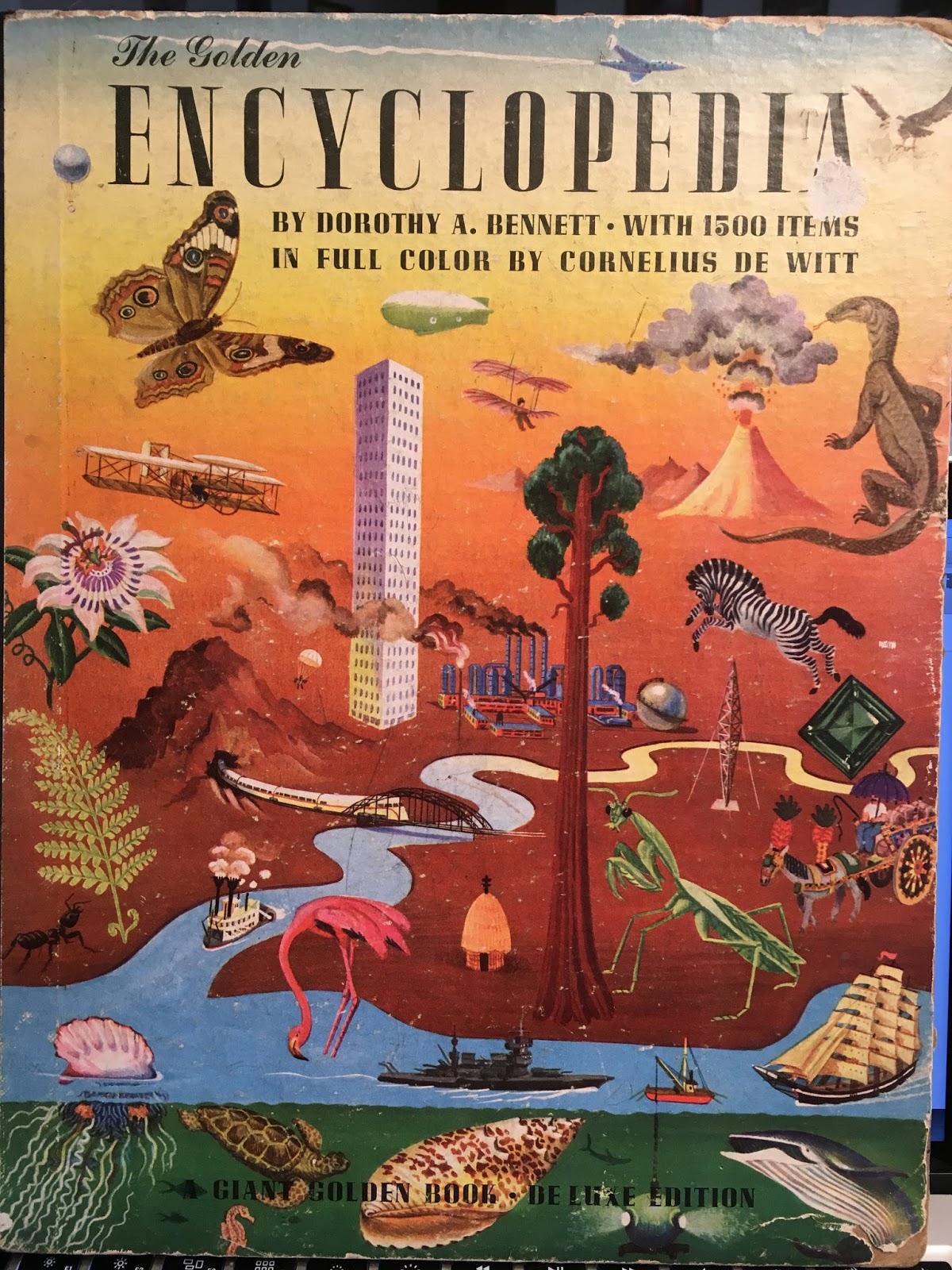
The Golden Encyclopedia.  Dorothy A Bennet.
Illustrated by Cornelius De Witt.
Simon and Schuster.  New York. 1946.
The Golden Encyclopedia was an expansion of Little Golden Books--a series of children's books conceived by George Duplaix, Lucy Sprague Mitchell and Lucille Ogle to be low-cost and using a new color technique. (1)  Bennett joined Duplaix, Mitchell and Ogle in 1943 and soon became instrumental in both authoring as well as editing Little Golden Books and Golden Books. (1)

But let's back up a bit, back to focus on Dorothy Bennett.  Unlike so many authors/illustrators of books I explore on this blog, Dorothy Bennet was not an author who published then vanished.  Far from it!  Dorothy Bennet was a renaissance woman who graduated from the University of Minnesota (and from the grasp of her over-protective parents) and pointed herself firmly towards adventure. (1)  Among her many achievements--beyond authoring--she served as an astronomer, anthropologist, was a radio personality, and was deeply involved in science education, often taking "junior astronomers" on camping trips to see stellar phenomena (1).

Needless to say, I could go on and on, but I won't (although I highly recommend you read her Minnesota Alumni bio listed below!)


So Dorothy Bennett knew her stuff.   However, she knew her stuff in the mid 1940's.   Which brings me back to my long-standing suspicion of children's encyclopedias.   Anything written by humans is biased, subjective and irrevocably stamped by time.  True objectivity, in my experience, is rare, if not nigh on impossible.  So as amazing as Dorothy Bennett was,  this encyclopedia is most certainly a product of its time.

Take for example the section on "Man".  In the mid 1940's, science classified people into watercolor boxes of skin tone.  We would rightfully consider this to be offensive  nonsense today (although vestiges of this classification certainly remain today in discussions of race--if we have moved beyond referring to people in terms of yellow or red skin, why do we still use "black" and "white"?  I have been asked this endlessly by my young students over the past 25 years and I have not yet found a satisfying answer.  But I digress.).  

However, in reading this section, I could tell that Ms. Bennett did work hard to present as balanced and scientific an explanation of racial differences as she could based on her background in anthropology.   I would argue that her  efforts in fact created their own subjectivity--for the mid 1940's, perhaps not everyone would've necessarily agreed with  her efforts to present  matter-of-fact, fairly reasonable-sounding information.

As I read this encyclopedia now, in 2016, I can easily point out the dated information--and at times flaws-- in Dorothy Bennett's descriptions.  However throughout the book Ms. Bennett's inner scientist shines through.  Her descriptions resonate as well-crafted lectures, enhanced and embellished by the intricate illustrations.

Which brings us to the illustrator, Cornelius De Witt.   Unlike Dorothy Bennett, Mr. De Witt IS something of an enigma.   


While the internet is replete with samples of his work, finding information about the man himself is nigh on impossible.  I could only find the most basic of information.  Cornelius De Witt was born in 1905 in Germany and passed away in 1995 in Massachusetts. (2)   However, where the man may have become inaccessible, his work lives on, and anyone who grew up in the United States Between 1940 up to the 1980's has most certainly run across Mr. De Witt's brilliantly colored and fascinatingly detailed illustrations.

When my friend handed me this book I ran adoring fingers over the brilliant colors and details on the cover, examined the binding and carefully opened it to the title page.  Then I did what I always do with vintage books:   I held it loosely in my hands and just let it fall open.

Most of the time these vintage books simply open to reveal text and illustrations for me to examine.   But once in a while the book will open up to reveal a hidden, long-forgotten treasure.

Such is the case with this encyclopedia.  When I first let it fall open, tucked into the "N" section was this paper:


It was an abandoned World History assignment, completed by a student in 1957.   My brain of course kicked into a heap of questions:  Who was this student?   What grade was he in?  The subject area would seem to point to a junior or senior high student.  If so, was this book once in his classroom or in the library?  Or was it a book he found laying around his house and he simply referred to it so he could  get his assignment done as quickly as possible?

Perhaps the most endearing part of finding this paper is that it reminded me of the assignments my own son tried to rush through when he was younger--the handwriting crammed together, the answers given in fast-forward bits instead of complete sentences.

And this is the essence of my love for vintage books.  Biased, dated, subjective, even sometimes offensive as they may sometimes be, they remind me where we used to be and where I used to be, and inspire me to keep looking forward, even as I peek back.


Sources

1. http://www.minnesotaalumni.org/s/1118/social.aspx?sid=1118&gid=1&pgid=3685&cid=5996&ecid=5996&crid=0&calpgid=3654&calcid=5955

2. http://www.askart.com/artist_keywords/artist/24291/artist.aspx


Tuesday, February 23, 2016

Readers and Primers and Spellers--Oh MY!

Much to my delight, I have recently found myself in a glorious position to help survey and catalogue the Weinstein Collection of antique and vintage children's books at National Louis University in Skokie, Illinois.

So a few days ago I was doing what I typically do when facing shelf upon shelf of these splendid books--I stared with my mouth hanging open and my eyes sliding along the laden shelves--waiting for that moment when a book jumped out at me.

And so it did:

Graded School Series First Reader by T. W. Harvey
Van Antwerp,Bragg  & Co. 1875
I looked at the front cover.  I read the title.


I looked at the back cover, noting the unavoidable blemishes and damage of time--the water stains, the missing corner, the yellowed, cracking pages.


And  my mind told me "EXCELLENT!  An early edition of a McGuffey's Eclectic Reader!"


Yes, in spite of obvious visual evidence to the contrary, I thought this was an early McGuffey's Reader.

When I gingerly opened this treasure, the pages  still looked McGuffey-like enough stylistically to not trigger my brain.


In fact, it wasn't until I had closed the book, had slid it gingerly back onto the shelf and had toted my photo-filled iphone home that I realized the truth--this was no McGuffey's.

I knew McGuffey's Readers.  I had taught for years at a private school that used McGuffey's as part of the primary reading program.   While we eventually had to lay aside the McGuffey readers to accommodate the push for modern reading curricula, I still always kept a soft spot for the McGuffeys.

For those of you not in the know, this is a McGuffey's Eclectic Reader:


https://www.rainbowresource.com/proddtl.php?id=025733


McGuffey's Eclectic Readers, written by William Holmes McGuffey, were the most well-known school readers, first published in 1836 and finally going out of print in 1960. (1)

McGuffey's Readers bridged the moral themes and some of the religious themes of its predecessors (namely The New England Primer) with contemporary stories that entertained as well as taught.


McGuffey's departed in style from other readers by presenting vocabulary and spelling lists as connected to stories, which gave students the opportunity to learn new words in context. (6)  This approach was perhaps one of the reasons for the longevity of McGuffey readers when other readers and primers that came before and after it seemed to fade away from use.


However, before there were McGuffey's readers, there was The New England Primer which has the honor of being the first U.S. printed school reader, first published in the United States in 1690. (2)

http://venezky.stanford.edu/colonial/

The New England Primer leaned heavily on the Bible for content and context, unsurprising considering the Puritan roots of Colonial America.

The New England Primer is noted for combining reading instruction with moral and religious themes that gave previously illiterate people the skills needed to read the Bible for themselves, rather than have to be at the mercy of others for spiritual comfort and learning. (3)


http://venezky.stanford.edu/colonial/
With The New England Primer  leading the way, and McGuffey's Eclectic Readers adding increasingly modern approaches to reading instruction (albeit still heavily religious and moralistic, not to mention skewed exclusively to  readers of a single  ethnic, cultural and religious background), the  path was laid for the next permutation of readers--The Graded-School Readers, by Thomas W. Harvey.

And thus we come full-circle, back to the reader at the start of this post.

Thomas W. Harvey started along the path of reading and book publishing at the age of 15, working as a print office apprentice. (7)  From here his professional life rose steadily--from attending a Teacher Seminary to founding a high school, becoming principal of that high school and then being elected as Commissioner of Common Schools.  It was in this last position that Thomas Harvey wrote a series of textbooks to be used in classrooms--several grammar and language books as well as a series of first readers and primers (7)--one of which I had stumbled across.  He published his first reader in 1877.  They stayed in print until 1927. (7)


Even from these small sample pages one can see the influence McGuffey's Readers must have had on Thomas Harvey as he wrote his own primers.   Also present in a number of stories are lessons in morality, although these lessons are presented a bit more subtly by Thomas Harvey than by either McGuffey or in the New England Primer.  Harvey's readers--like the New England Primer and McGuffey readers that came before--still reflected a uniformly white, Anglo-Saxon, Protestant perspective of course.   This might have been a non-issue in the United States in the 1800's and early 1900's--however it is telling that even now, 300 years later, children's books still fail--in quantity and even at times in quality-- to faithfully reflect the diversity of real life.


When I consider these three early readers, I find myself automatically comparing and contrasting them with textbooks and phonics programs I have used over the past  25 years I have  taught in  primary programs.   In the end, what we do today rests heavily on what has come before--teaching vocabulary and spelling in context, trying to present stories that have meaning and connection with student's lives, and above all nurturing the reading skills in our young students that will empower them to take charge of their own learning.   Just as the New England Primer over 300 years ago strove to enable people to read and interpret the Bible for themselves, don't we, in the end, teach children in order for them to break away and interpret the world for themselves?


Who knew that such history, power and influence could be hidden inside such a small book?


Sources

1. ttps://en.wikipedia.org/wiki/William_Holmes_McGuffey


3.  http://familyphonics.com/ab/ab1/history.htm

4. http://venezky.stanford.edu/colonial/

5. https://www.rainbowresource.com/proddtl.php?id=025733

6. http://www.mcguffeyreaders.com/1836_original.htm

7. http://www.findagrave.com/cgi-bin/fg.cgi?page=gr&GRid=22786693