Showing posts with label Illustrator. Show all posts

Saturday, August 13, 2016

ぞうのホートンひとだすけ (Horton Hears a Who)


(3)


Last week I was once again huddled on the floor in the vintage books  corner of "Half Price Books".

My eye caught sight of a familiar orange-spined children's book.   The corners of the front and back cover were predictably soft and rounded.  Inside on the front end paper a name was printed in bold, decidedly adult handwriting and a large, faint ball point "X" had been scrawled across the smiling elephant face on the front cover.  I got a strong, happy vibe that this may have once been a teacher's book.

Aside from these signs of age, the book was in very good condition.  I levered myself off the floor and sat in a chair, "Horton Hears a Who" gently cradled in my arm.

"Horton Hears a Who!", written and illustrated  by Dr. Seuss (Theodor Geisel)  is just one of Dr. Seuss'  many iconic, instantly-recognizable and, indeed, universally beloved creations.  Dr. Seuss' works have been translated into over 20 languages (2) including, of course, Japanese.

And yes, there is a reason I am fixating on Japanese.

(3)
I looked at the copyright date inside the front page--the year "1954" hovered  near the bottom. Not quite trusting that I was holding a first edition book, I pulled out my iphone and after about 15 minutes of poking at the tiny screen, I ascertained I was indeed holding perhaps a 1965  or 1966 edition, based on the back cover details and the fact that the list  Other Books by Dr. Seuss in the front of the book ended with two books published in 1965: "I had Trouble Getting to Solla Sollew" and "Fox in Socks" (10).

 As a student I must have read this book--or had it read to me--countless times.  As a Early Childhood/Kindergarten teacher I must have read it aloud to students a hundred times more--at least--over my 25 years as a teacher.  I recognized each picture. I recalled each turn of phrase.


(3)
But there was one thing I did not recall noticing.  Not once.

The dedication.

"For My Great Friend,
Mitsugi Nakamura
of Kyoto,
Japan."


How was it that I had never noticed this before?  I lived for coincidences like this.  I had lived in Japan for 8 1/2 years--5 of those years in Kyoto.  And here was a detail in a beloved children's book just screaming coincidence.  Even more perplexing was the fact that I always, ALWAYS pointed out the dedications in the books I read aloud to my students.  Doing so not only brought us closer to seeing the author as a real person, but sometimes also planted a tiny seed in many students about who THEY would dedicate a book to, if THEY were to write a book.

So how did I miss THIS dedication?


Before I could try to discover the identity of Mitsugi Nakamura I had to step back a bit, before "Horton Hears a Who!" was written, back to World War II. Back to the years 1940 to 1948, when Theodor Geisel was the chief editorial cartoonist for the New York newspaper PM. (4)

(8)
Throughout World War II Theodor Geisel turned his talents, not to writing and illustrating whimsical tales of cats and elephants, but to creating scathing political cartoons and newsreels  that caricatured and demonized those people and countries against whom the United States was fighting in the war--namely Germany and Japan.(5)   While many sources I could find described Geisel as a supporter of civil rights, women's issues and labor unions (5, 6), at the same time he was creating anti-German and anti-Japanese political cartoons which he considered to be part of the defense of his country in wartime. (4)  He, like so many other Americans, felt it was his patriotic duty to stand against Germany and Japan--a duty carried out as much through  his art  as through his 1943 enlistment in the Army as part of Frank Capra's Signal Corps unit.(4,8,11)


So if Theodor Geisel was so anti-Japanese, how is it that he dedicated  "Horton Hears a Who!"  to his "...Great Friend, Mitsugi Nakamura, of Kyoto, Japan"(1)?

Simple.  He went to Japan.

On March 23rd 1953 Theodor Geisel visited Kyoto, Osaka and Kobe Japan (4,7,8).    He went there on assignment by the Ford Foundation to investigate the effects of World War II upon children and to ascertain the effects of the American occupation. (8) Geisel's friend from Dartmouth, Professor Donald Bartlett, arranged for him to meet with teachers in each city, who then had their students draw pictures to give Geisel of what they hoped to become in the future. (8)

I don't think it is too much of an exaggeration to say that his trip to Japan was life changing.

It is as true now as it always has been:  it is much harder to demonize people once you get to know them. Once you see the world through their eyes.

It was during that trip that Professor Bartlett  introduced Geisel to  Mitsugi Nakamura, who was then Dean of Doshisha University in Kyoto. (8)

According to sources I could find, a close and lasting friendship grew between Geisel and Nakamura-san, with multiple trips made to visit each other over the years and Nakamura-san's daughter even being sponsored by Geisel and his wife to attend college in California. (8)

Geisel's trip to Japan ultimately fueled his desire to write "Horton Hears a Who!"--a book that
has been interpreted to represent Geisel's desire to offer protection and guidance to Japan as they tried to heal from the war, and more specifically, from the bombs that the U.S. dropped on Hiroshima and Nagasaki. (12)  Across all the articles I read, there was a general consensus that "Horton Hears a Who!" was written as both an apology of sorts for Geisel's earlier, war-tainted views against the Japanese people, as well as a cautionary tale for all of us, countries, governments and individuals alike.

In the course of researching for this post, I came across many academic papers, opinion pieces and blogs that asked multiple versions of the same questions:  How can we reconcile that Dr. Seuss, creator of so many powerful, beloved children's books, was the same man who once drew such painful, racist and dangerous political cartoons? And can we forgive him?

This is perhaps a question wrongly put.

It is not for us to forgive.   Theodor Geisel chose to re-evaluate his beliefs rather than allow himself to stagnate in his former fear and hatred of former enemies.  He kept growing, not towards perfection (a human impossibility), but towards greater understanding.

"Horton Hears a Who!" may have been partly written as an apology. However as I re-read it now, it seems instead to  reflect Geisel's attempt to share the lessons he learned, perhaps with an eye towards building a better future.

The question  is not "Can we forgive him?" but rather "What can we learn from him?"

As it turns out, we can learn perhaps a great deal, and not just through his words and pictures.


Sources

1. http://www.ebay.ie/itm/Horton-Hears-a-Who-Japanese-Edition-Dr-Seuss-/162150032379?hash=item25c0e523fb:g:kn8AAOSwTZ1XmMHG

2. https://en.wikipedia.org/wiki/Dr._Seuss

3. "Horton Hears a Who"  Dr. Seuss.  Random House. New  York.  1955.

4. http://www.openculture.com/2014/08/dr-seuss-draws-racist-anti-japanese-cartoons-during-ww-ii.html

5. http://www.history.com/news/when-dr-seuss-went-to-war

6. http://www.truth-out.org/news/item/14765-radical-reading-the-progressive-dr-seuss

7. https://derwombat.net/2015/08/06/after-visiting-hiroshima-dr-seuss-atones-with-a-book/

8. http://www.drseussart.com/horton-60/

9. http://1stedition.net/blog/2007/01/horton_hears_a_who_1954.html

10. http://www.best-books-for-kids.com/list-of-dr-seuss-books.html

11. http://masshumanities.org/about/news/f04-pds/

12. https://seussblog.wordpress.com/tag/dr-seuss/page/7/

Saturday, July 2, 2016

Troubling Tales of Children of Other Lands

And lo last week  I found myself at one of my  favorite bookstores, "Bookends and Beginnings" in Evanston, Illinois.

So of course I bought some books, including this intriguing tome--"Children of Other Lands".

(1)
This was no pristine collectors item...which only intrigued me more.  Published in 1933, this copy of "Children of Other Lands" had clearly been a hands-on book.  Nearly every page includes what seem to be determined graffiti by a child--from the pencil scribbles on  the cover to the random additions of orange crayon on nearly every illustration.   Pages are ripped and the once sturdy red binding is feathering.

 I didn't have to look far to find the identity of the child.  He proudly wrote his name 3 separate times on the end papers:  Herbert Benjamin Nechin.

At first I wasn't sure how I felt about little Herbert embellishing such a lovely book--did the book bore him and he felt he had no alternative but to turn it into a coloring book?  Or did he love the book so much that it was his go-to resource for artistic inspiration?

Hard to say.


After reading this book, however, I found myself hoping that Herbert was expressing his distaste for the text, rather than sharing his approval.

The book is divided into twelve separate stories that tell the tales of representative children from lands around the globe.
(1)

Each story gives an overview of the specific country including geography, transportation, boats, customs and a smattering of history.  Individual children from that country are then described in terms of dress, food, entertainment and personality.

I can't put my finger on what precisely makes my skin crawl about these descriptions.    While I can forgive some of the ignorance of global cultures indicative of the 1920's and 1930's, I'm not sure I can so easily let go of the patronizing comments and rhetorical questions, such as in the second story about Japan, where the author points out about the Japanese people "Their skin is not white like yours, but light yellow.  Like the Chinese, they belong to the Yellow Race. Their eyes do not open as widely as yours, which makes them appear to be slanting."  And at the end of the story "How hard it is to say sayonara, which means good-bye in Japanese, to such an interesting country as Japan and to such pleasant little companions as slant-eyed Togo and Yuki-san!".


(1) 
Nearly all of the twelve stories contain at least one shudder-worthy description.

Which brings us to the author--Watty Piper.   Who was this Watty Piper?

Well, Watty Piper did not exist.

"Watty Piper" was the pen name of Arnold Munk (yes, the "Munk" of the publishers Platt & Munk.) (2)     Arnold Munk/Watty Piper is perhaps best known for writing "The Little Engine That Could". (2)

Arnold Munk (3) 


I wasn't able to find much satisfying information about Arnold Munk, aside from his daughter's apparent disapproval of his pen name. (3)    I found this curious, since Arnold Munk/Watty Piper authored several well-known children's books that have stood the test of time (although "Children of Other Lands" is not necessarily one of them).

The illustrators, however, were another story.

Lucille Webster Holling and Holling Clancy Holling were a husband and wife illustrating team who met while attending the Art Institute in Chicago, Illinois. (5)

(4)


Holling C. Holling was an avid naturalist and science-lover as well as an amateur ethnographer. (5) Lucille shared many of his interests (5) which leads me to wonder how much of the text of "Children of Other Lands" was influenced by Lucille and Holling.

The illustrations in "Children of Other Lands" are rich and detailed.  The elaborate watercolor pictures are thought to be Lucille's work, while the black and white ink drawings are believed to be those of Holling. (5)

(1)
(1)


It pains me to see such beautiful--although at times stereotypical--illustrations paired with text that includes  such cringingly dated and even ignorant descriptions of world cultures.

Which is why I find I must step back from this book in order to view it as a time capsule rather than a resource.

"Children of Other  Lands" gives us a peek into how people in the early 1900's viewed the world and the people around them.  While this book does contain interesting factual information, at the same time it is replete with dated, superficial stereotypes about people and cultures.

The sad thing is that I cannot say with certainty that we have left all of these stereotypes behind--
which makes this  book is a poignant reminder that many times beauty, truth and ignorance are often intertwined and can fool us unless we take a closer look.


Sources

1. "Children of Other Lands"  by Watty Piper, Illustrated by Lucille W. and H.C. Holling.  The Platt & Munk Co. Inc. 1933. 

2. http://plotnick.people.uic.edu/littleng.htm

3. http://www.npr.org/2014/07/08/329520062/in-little-engine-that-could-some-see-an-early-feminist-hero

4. http://hollingcholling.blogspot.com/2015/05/who-was-that-writer-with-odd-name.html

5. http://www.dbdowd.com/illustration-history/2015/11/13/the-hollings-lucille-webster-holling-holling-c-holling

Wednesday, June 15, 2016

Wonderful Wordless Discoveries


In my explorations of used book stores, resale shops, Goodwills and library sales, I seek out--and often find-- rather odd vintage books.  More often than not, these are books that fascinate me and no one else.

But once in a great while I stumble across something truly splendid.

This is one of those great whiles.

"What Whiskers Did". Ruth Carroll. The Macmillan Company. 1937.

I found this book amid the vintage clearance books at Half Price Books.  The bold block letters on the bright orange spine  caught my eye and inspired me to slide it off the shelf.

 I readily recognized Ruth Carroll's name as an illustrator  (usually in collaboration with her husband, author Latrobe Carroll) that steadily created and published children's books from the 1930's until the mid 1970's. (10) What really excited me was that this was an unusually early  wordless children's picture book.  

Wordless picture books for children may seem completely unremarkable now, but once upon a time the books that were published specifically for children always had words to accompany the illustrations.  


There is, of course, a vast swath of human history devoted to using visual images to communicate.  These include everything from cave paintings and hieroglyphics to wall hangings and stained glass windows. (11).

There are but a handful of surviving examples of early wordless books--most from Europe--of these around half were not intended for children. (11).

Which brings us to "What Whiskers Did".   In my used book store bumblings, it seems I had stumbled upon a 1937 copy of the first wordless children's book published in the United States.

"What Whiskers Did" first edition was printed on July 19th, 1932. (12)  It went through a number of reprints until Ruth Carroll updated it and reissued a second edition in 1965. (3, 8)


But before we get into various editions, let's take a peek at the original.

The original edition of "What Whiskers Did" makes sure to point out the absence of words right on the title page--a fairly clear indicator of the unusual nature of such a book at the time.


Whiskers is a bouncy scottie dog enjoying a walk on his leash with his human--a young boy.


Suddenly he spots some tracks...


Snaps his leash...


and takes off only to find himself on the receiving end of the hungry attentions of a wolf.


Whiskers escapes the wolf by ducking into a rabbit's hole, where he joins the resident rabbit family for dinner and games.


Afterwards Whiskers returns to reassure his crying owner that he was not lost--just having a little adventure.


Caryn Schafer points out in her children's book blog "Three Books a Night" the delightful way Ruth Carroll pushes the illustration out of the frame--interrupting the story just as the tracks in the snow interrupted Whisker's walk. (3).   Carroll continues using this style throughout the story, allowing the fluffy rabbit tails, backs of chairs and bouncing baby bunnies escape the stiff lines of the frame.

I was also struck by Carroll's skillful use of white space to bring dramatic focus on the action in the story.  The clear black details surrounded by white makes it easy to focus on the facial expressions of the animals and progress of the action.

I loved everything about this book,  so it was with a little concern that I discovered that Ruth Carroll updated it in the mid 1960's. (3, 6).

While the story seems to remain the same (I have not yet been able to acquire a copy of the updated edition to compare), the illustrations underwent a noticeable change.

(9)


Most importantly, Carroll changed the breed of dog from what seemed to be an adult scottie dog to a poodle puppy.   Both dogs are adorable, and beautifully detailed and probably equally believable as bunny defenders.

But I couldn't help but feel a bit let down by the loss of the scottie dog.   The original Whiskers seemed to bristle with personality, his trademark scottie whiskers even lending him a kind of gentlemanly dignity.


(9)


Another change that rather alarmed me was the much more realistic look to the chase between the rabbit, wolf (in the new edition depicted as a fox) and Whiskers.


If we compare the updated version and the original,  the updated version is much more frightening,with the sharp teeth and snarling mouth of the fox front and center, and Whiskers seemingly much more frightened and threatened.


It is perhaps my love of original versions and vintage books that biases me against the 1965 update of "What Whiskers Did".  However there is one thing that remains the same.   "What Whiskers Did" stands out as one of the proud forerunners of the multitude of amazing, artistic and powerful wordless books created today, and even better, a story that, in relying on a child's imagination to tell the tale, has stood the test of time quite well indeed.


Sources


1. http://www.publishersweekly.com/pw/by-topic/childrens/childrens-authors/article/70140-the-wordless-picture-book-a-panel-discussion-at-politics-and-prose.html

2. https://books.google.com/books?id=09-XR0gKk9AC&pg=PA13&lpg=PA13&dq=what+whiskers+did+first+wordless+picture+book&source=bl&ots=tfh38aBqp4&sig=k88B8GgvHteRHnh72jiilmawFpo&hl=en&sa=X&ved=0ahUKEwiD0-r56qjNAhVlF2MKHYGbBRUQ6AEIJTAB#v=onepage&q=what%20whiskers%20did%20first%20wordless%20picture%20book&f=false

3. http://www.threebooksanight.com/book-reviews/what-whiskers-did-by-ruth-carroll/

4. http://specialcollections.vassar.edu/collections/manuscripts/findingaids/carroll_ruth.html

5. https://www.lambiek.net/artists/c/carroll_ruth.htm

6. http://archiveswest.orbiscascade.org/ark:/80444/xv19166

7. http://www.abebooks.co.uk/book-search/title/what-whiskers-did/author/ruth-carroll/

8. https://www.etsy.com/listing/270948706/what-whiskers-did-by-ruth-carroll-1965

9. http://furuhon-awayama.ocnk.net/product/546

10. https://en.wikipedia.org/wiki/Ruth_and_Latrobe_Carroll

11. http://www.americanreadingforum.org/yearbook/yearbooks/97_yearbook/pdf/06_Dowhower.pdf

12. https://books.google.com/books?id=lNcgAQAAIAAJ&pg=PA781&lpg=PA781&dq=what+whiskers+did+ruth+carroll+reprints&source=bl&ots=Cuc_RKimJM&sig=UoI0c-ITPfmOXKHAy-IBwGmhw7g&hl=en&sa=X&ved=0ahUKEwjBus3y7arNAhUMM1IKHeGbCI0Q6AEIQTAH#v=onepage&q=what%20whiskers%20did%20ruth%20carroll%20reprints&f=false

Saturday, May 21, 2016

The Unexpected Imagination of Tom Seidmann-Freud


(6) Photo courtesy of Max Halberstadt 1921


When a person hears the name "Freud" I would imagine that a very specific image  comes to mind.

This one. The stern, bearded face of  Sigmund Freud, famed father of psychoanalysis.


Yet I'd argue that as intriguing as Sigmund Freud was, he was by no means the only member of the extensive Freud family worth learning about.


I was meandering my way through the Weinstein Collection of vintage and rare children's books (which I have the honor of working with  through my position with the Center for Teaching Through Children's Books in Skokie, Illinois).   There were many distracting treasures.  And then I saw this:


Everything about it piqued my interest, not the least of which was the mysteriously free-floating orange fish and the author's name--Tom Seidmann-Freud.

Tom was born in Austria in 1892 under her  given name Martha Gertrude Freud. (7)  Her mother, Mitzi, was Sigmund Freud's younger sister and her father, Moritz, was Sigmund and Mitzi's cousin. (7)

Before World War II Tom enjoyed a privileged life, growing up in Berlin and later attending art school in London. (1)  Tom abandoned her given name "Martha" as a teenager in hopes that using a masculine name would smooth her path as an artist. (1).  Many sources claim that Tom also dressed in men's clothing, although there are family members who dispute this. (1)

A number of sources I found described Tom as a sensitive, nervous child who grew into an adult with emotional issues and a tendency towards eccentricities, including her name change, mens clothing and heavy smoking. (2)(3)

(1) Angela and Tom Seidmann Freud
When Tom was 28 years old she fell in love with Jakob Seidmann, marrying him a year later and giving birth to their daughter, Angela, a year after that. (1)  Throughout this time Tom created a number of children's books including "Peregrin and the Goldfish", published in 1929. (1) Her books received favorable reviews, but sadly many of Tom's creations--books as well as works of art--were destroyed when Hitler came into power. (2)

In 1922 Tom and her husband decided to partner up with the Hebrew poet Chaim Nachman Bialik to create a publishing company called "Ophir". (1)  They put their trust in the wrong person however. Bialik betrayed them, refusing to contribute his share of funds to the fledgling publishing company. As a result Tom and her husband were left penniless. (1) Jakob was unable to come to terms with this failure. He committed suicide in 1929; Tom followed a year later, starving herself to death. (1)  They left behind their daughter Angela, who was seven years old. (1)


Tom's  books and artwork that survived the Nazi purge point to a complex, tremendously creative woman.  The book I was lucky enough to stumble across is a testament to her talent.

"Peregrin and the Goldfish" begins with a boy named Peregrin who falls asleep beneath a tree and begins to dream.


The dream  begins softly--Peregrin sees himself carrying his pet goldfish, Nickeling, in a bowl as he  makes his way through a skewed world of tilted, rainbow-hued houses.

And then he falls down, dropping and shattering the bowl on the ground.

 Nickeling the goldfish swells up to huge proportions.

Freed from his bowl (and now appropriately large), Nickeling encourages Peregrin to accompany him to "...go out into the world together, for there is much to see.  Come with me!"

Nickeling brings Peregrin to yet another strange land.  Peregrin feels frightened and out-of-place, but soon enough he begins meeting an array of children who reach out to him.


Peregrin joins the children, helping them with their various daily tasks--picking fruit, selling the fruit at market, building houses, studying books.

Finally, exhausted and homesick, Peregrin calls out to Nickeling to bring him home.

Nickeling appears, takes Peregrin into his mouth.  The fish carries Peregrin into increasing darkness, finally diving down into the water until Peregrin wakes up.


The story and writing style (albeit translated from the original German) is simple and almost musical at times.

However the tale has an underlying darkness that I can imagine children delighted in as well as feared.  The images of odd landscapes, unknown people and an eventual plunge into darkness are the stuff from which  fears and troubling, thrilling dreams rise.

These dark undertones  seem all the more obvious when paired with Tom's crisp artistic style (a stencil and layering method called 'pochoir' (2)), the clean lines and pure jewel tones of the colors almost like folk art.  While not all of Tom's work follows this style, many of her books certainly do.

The tragic lives of Tom Seidmann-Freud, her husband and daughter  are but one piece of the troubling story of the entire Freud family.  Tom's mother, Mitzi, outlived her daughter  only to be put to death in a Nazi Concentration Camp in 1942. (7)  Four of Sigmund Freud's five sisters died in Concentration Camps, the rest of the Freud family splintered apart in their search for refuge. (7)

Reflecting upon Tom's life, I find myself wondering how much of her   unique sensibilities snuck onto paper through story and art.  The bright surfaces of Tom's art seem to  hide intricate and unexpected secrets, and I find myself unable to look away.

Although many of Tom's books and works of art were destroyed in the Nazi purge during World War II, enough (now very rare) copies survive to give us a peek into Tom Seidmann-Freud's volume of work that includes fairy tale books, moving picture books, counting books as well as illustrations completed for other writers. (2)

As I hold this copy of "Peregrin and the Goldfish" in my hands,  I can only feel gratitude for the chance to learn about Tom, and sadness for all that was lost.


Sources

1.  http://www.tabletmag.com/jewish-life-and-religion/92277/not-a-fairy-tale

2. http://www.tomseidmannfreud.com/

3. http://50watts.com/The-Rabbit-Dreams-of-Dr-Freud-s-Niece

4. http://marjorieingall.com/the-sad-short-life-of-tom-seidmann-freud/

5. https://www.geni.com/people/Tom-Martha-Gertrude-Freud/6000000015578563662

6. https://en.wikipedia.org/wiki/Sigmund_Freud

7. https://en.wikipedia.org/wiki/Freud_family

Sunday, May 8, 2016

Telling It Like It Is on Mother's Day


My dear, equally book-crazed friend Sue gifted me a vintage book in honor of Mother's Day.

The Wonderful Story of HOW YOU WERE BORN by
Sidonie Matsner Gruenberg. Illus. by Hildegard Woodward.
Garden City Books. Garden City, NY. 1959.
This particular book is especially well-suited to Mother's Day as it is all about where babies come from--yes, that parentally-dreaded, all-important question to which parents know the answer, but don't know how to say the  words.

Considering that this book was first published in 1952, I at first rather expected it to either offer the standard stork/cabbage patch variety of explanation, or perhaps hide beneath vague euphemisms (neither of which, I might add, a child particularly needs or wants when asking this very important question).

The author, Sidonie Matsner Gruenberg  was born in Austria in 1881 and educated in Germany and New York (1).

From 1906 until 1961 she worked as a world-famous parenting and child expert, serving as director for the Child Study Association of America, conducting parenting lectures, serving on editorial boards for Parent's Magazine and Child Study and working on various White House subcommittees on behalf of children and parents. (1)

In addition to these achievements, she authored over 15 books on child issues and parenting aimed at both children and parents. (2)

What all this boils down to is that the book I hold in my hands was written by someone with considerable clout--so if this is the way Sidonie Matsner Gruenberg answers the question "where do babies come from?", then chances are this is a good way for most of us to answer the question.


 And just how does she answer this question?

Honestly.
With precocious and splendid honesty.

I was first struck by the cover.  Ms. Gruenberg and illustrator Ms. Woodward started right away visually reinforcing that how YOU were born is how EVERYONE was born.  Pretty much.

Now, Ms. Woodward could have drawn a few little adorable babies and left it at that--a few little 1959-ish white babies in bonnets and bibs. I may be generalizing a bit, but not by much I feel, based on the many, many illustrated covers of vintage 1950's children's books I have seen with my very own eyeballs.

But Ms. Woodward's  cover illustration offers a selection of children from obviously different backgrounds (delightfully enough, depicted from the front as well as the back on the book covers).   Both the cover art and the title page art seem to exude a kind of  idealized multi-ethnic spirit of childhood that appeals to the idealist in me.  The illustrations throughout the book are just soft and ambiguous enough to represent people from any number of countries.

And paired with these gentle, lovely illustrations is Ms. Gruenberg's carefully crafted text.


Ms. Gruenberg starts right off acknowledging how parents try to avoid answering the "Where did I come from?" questions and covers the gamut of standard answers:  babies are found under cabbage leaves (this explanation illustrated in rather disturbing detail at the bottom of page 3), are ordered from stores via mail order, are delivered by storks or brought by fairies.

The rest of the book is then dedicated to telling the REAL story--beginning with a gentle foray into the fact that  all living creatures--including humans-- come from eggs.


Ms. Gruenberg describes how the egg grows in the mother's womb (in the case of mammals) and describes the key changes that happen as the baby grows.


"A baby lies in the womb with his head near a passage in his mother's
body that leads to the outside.  This narrow passage is called the
vagina."   (pg.13)


There is then a description of childbirth itself that is in equal parts careful and blunt.  Ms. Gruenberg is careful to avoid absolutes:  "Most babies are born in a hospital because this is a convenient place for mother and baby to get all the attention they need." (pg. 17).   And while she mentions the pain of childbirth, she does so with reassurances for a young child listening to this book  and learning about this topic for the first time.
                                                                                         

On page 22, in the second half of the book, the father's contribution to the creation of a baby is explained--again in careful, honest detail using specific vocabulary.  


"In the mother's womb the egg is ready to begin
to grow into a baby.  But only if it is joined by
something else.  This very important something
is called a 'sperm', and it comes from
the father's body."  (pg. 22)

At this point the book seems to sigh with a bit of relief, having  succesfully navigated the murky waters of introducing the terms  "vagina" and "sperm" (or perhaps the sighing I hear is the collective timeless sighing of thousands of parents reading this book to their children.)

At any rate, the rest of the book is straightforward, discussing how the baby grows from an infant into a child, from child to teenager, from teenager to young adult.


The last few pages of the book skirt just a bit timidly  around the topic of puberty, the leap into a final technicolor celebration of family which while abrupt, is pleasing never the less.


I was pleasantly surprised by this book--by it's honesty, by the illustrations that sought to represent many different kinds of people, by the way it offered an easier way for parents to introduce a challenging topic to their children.

A final new edition was published in 1970.  This new edition included an enlarged  format and updated  text and  illustrations  (some of which, according to one Goodreads review, they "wouldn't want a younger child accidentally coming across." (3))

(4)

This is one vintage book that I feel has weathered the passing years quite well, even in its original edition.  Of all the lessons and information parents must pass on to their children,  the most difficult are those that strike the closest to our emotional hearts--birth and death, love and loss, pain and passion.

There is something  in this book, with its  gentle, pastel-tinted treatment of reproduction, parenthood and family, that is timeless and appropriate.

Especially for Mother's Day.


Sources

1. http://www.jewishvirtuallibrary.org/jsource/judaica/ejud_0002_0008_0_07935.html

2. https://www.goodreads.com/author/show/672138.Sidonie_Matsner_Gruenberg

3. https://www.goodreads.com/book/show/2691722-wonderful-story-of-how-you-were-born

4. http://www.amazon.com/Wonderful-Story-How-Were-Born/dp/0385036744

Friday, April 1, 2016

Pampeliška (Dandelion)


Dandelion by Ladislav Svatos. Doubleday & Company, Inc. 1976.


Finding a splendid vintage book with a complex history is so very satisfying when achieved in a bookstore.   However finding a splendid vintage book is infinitely MORE satisfying when you stumble upon it.

And when it comes to stumbling upon books,  I will blushingly suggest that I am a fantastic klutz.

I stumbled upon this treasure-- Dandelion by Czechoslovakian artist and writer Ladislav Svatos--in a Goodwill store in Wheaton, Illinois.

This particular Goodwill store has become one of my favorites.  Thrift stores depend on donations, and this particular Goodwill store seems to be fed a rich diet of library castoffs, attic evacuations and downsizing diamonds in the rough.

Much to my dysfunctional delight.

Finding out more about author Ladislav Svatos proved to be as eye-opening as it was challenging--primarily because most of the information about Svatos is in Czech.  And unfortunately I cannot read Czech.  However I AM quite skilled at plugging  Czech words into translator internet search engines.

And so I did.

Even with the inevitable garble of trying to read computer-translated Czech,  I immediately sensed that Ladislav Svatos was a man with a story to tell.
Ladislav Svatos (2)

Ladislav Svatos was born in 1929 in the Czech Republic. (2)  I wasn't able to dig up much on his early years, mostly I suspect because I cannot read Czech and thus cannot hopscotch between Czech-langauge websites to follow clues and hints as I do in English.

But I was able to uncover one bit of information on a Czech website that seems to be dedicated to former Czech political prisoners of the communist regime. (1)  This regime stretched from 1948 to 1989. (3)  Under this regime, those individuals deemed "dissidents"--including members of the Catholic church of which Svatos was a member (1)-- were removed from society. (3)

According to this website, in 1951 Svatos and a fellow church member were accused of being "agents of the Vatican" and were sentenced to imprisonment. (1)  Svatos was sentenced to 12 years imprisonment, while the other man was sentenced to 24 years. (1)

After being released from prison Svatos went on to have a family and to become a well-known designer and graphic artist (1), evidence of which I hold in my hands in the form of Dandelion.


The book Dandelion itself is visual poetry.   The stark black ink drawings on white with just touches of yellow and green  are graceful and  perfectly complement the clean botanical descriptions of the life of a dandelion.

As I read through this book several times, I was strongly reminded of Japanese ink drawings, where the simple elegance of black ink designs on white paper tells a story as much in what ISN'T there as what IS.

The empty spaces are nearly as beautiful as the illustrations.


At times, in fact, there seems to be hidden qualities in some of the drawings.  Take, for example, the drawing below of a dandelion sprout just starting to take root.  The shape of the root itself seems to take the form of a tiny human body, arms outstretched.


Similarly, in one of the last illustrations in the book, of a fully white dandelion flower just starting to release its seeds to the wind, there is something expressive in the way the dandelion is posed--almost like it is standing, tiny green hands perched on hips.  The releasing seed parachutes almost look like tiny outstretched hands.


Dandelion is a beautiful book, melding plant science and poetry in nearly perfect balance.   It celebrates one of the most ubiquitous and humble flowers--a plant that is usually uprooted as a troublesome weed and seldom held up for its simple beauty and usefulness (dandelions have traditionally been used as  food as well as to help treat various disorders). (4)

As far as I can find, while Svatos' work can be seen in various other areas, such as on book cover art, postcards and  in illustrations, Dandelion may have been his only children's book.

I find myself wishing this were not so.


Sources

1. http://www.kpv-praha15.wz.cz/kpv_SOVF_clanek51.htm

2. http://www.isabart.org/person/4129

3. https://en.wikipedia.org/wiki/History_of_Czechoslovakia_(1948%E2%80%9389)

4. http://www.motherearthnews.com/real-food/benefits-of-dandelion-greens-zmaz08amzmcc.aspx


Tuesday, March 22, 2016

The Subjectively Objective World of the Encyclopedia

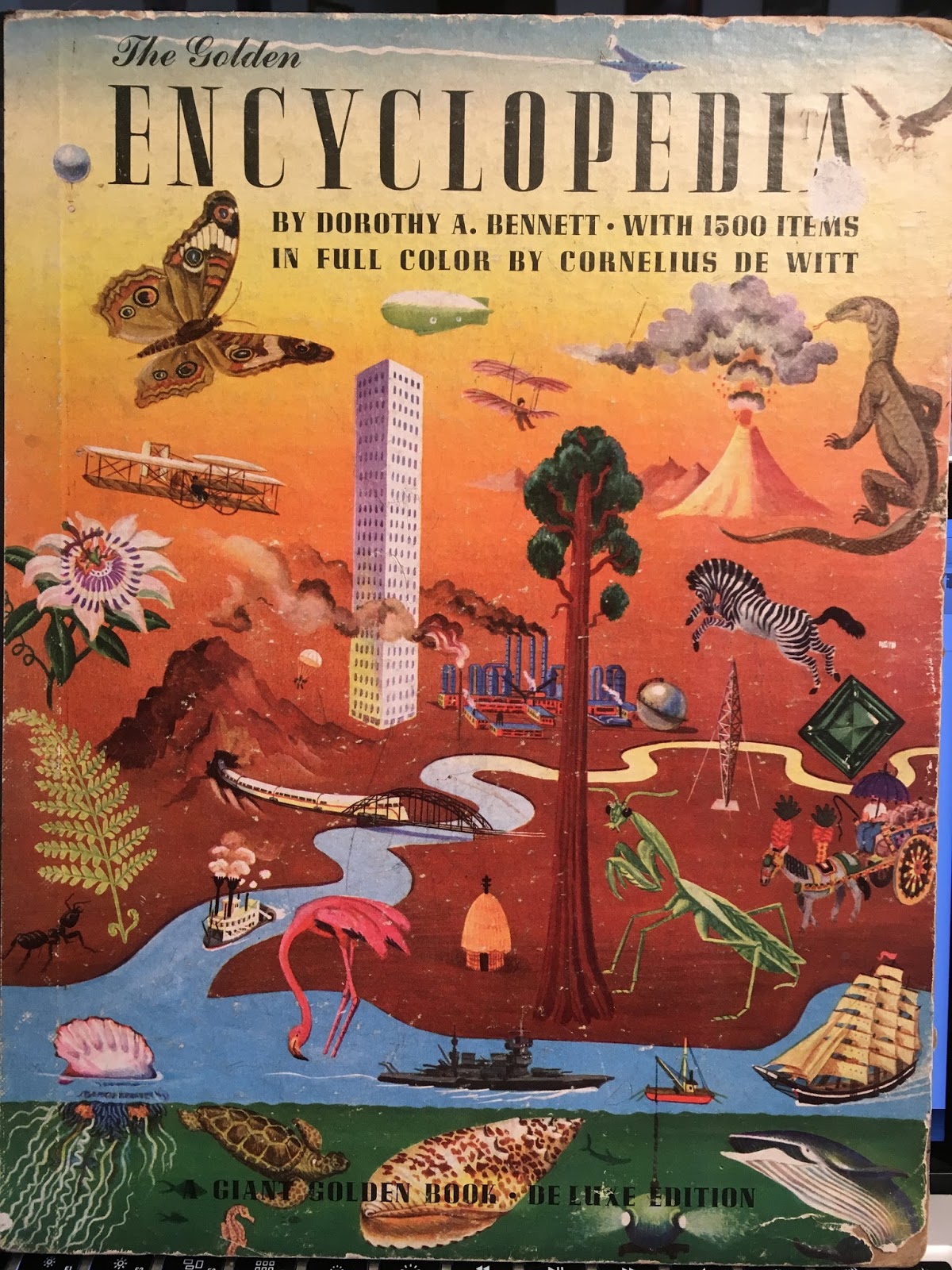
Children's encyclopedias seem to me a curious thing.  Even as a child I approached children's encyclopedias with suspicion--how could one book, or even a collection of 8, 10, 12 books or more, possibly begin to explain everything in  the world?

The children's encyclopedia that is now open before me is one I cannot take credit for finding.  It was a gift from a dear, book-loving friend who is well acquainted with  my passion for vintage children's books.

The Golden Encyclopedia.  Dorothy A Bennet.
Illustrated by Cornelius De Witt.
Simon and Schuster.  New York. 1946.
The Golden Encyclopedia was an expansion of Little Golden Books--a series of children's books conceived by George Duplaix, Lucy Sprague Mitchell and Lucille Ogle to be low-cost and using a new color technique. (1)  Bennett joined Duplaix, Mitchell and Ogle in 1943 and soon became instrumental in both authoring as well as editing Little Golden Books and Golden Books. (1)

But let's back up a bit, back to focus on Dorothy Bennett.  Unlike so many authors/illustrators of books I explore on this blog, Dorothy Bennet was not an author who published then vanished.  Far from it!  Dorothy Bennet was a renaissance woman who graduated from the University of Minnesota (and from the grasp of her over-protective parents) and pointed herself firmly towards adventure. (1)  Among her many achievements--beyond authoring--she served as an astronomer, anthropologist, was a radio personality, and was deeply involved in science education, often taking "junior astronomers" on camping trips to see stellar phenomena (1).

Needless to say, I could go on and on, but I won't (although I highly recommend you read her Minnesota Alumni bio listed below!)


So Dorothy Bennett knew her stuff.   However, she knew her stuff in the mid 1940's.   Which brings me back to my long-standing suspicion of children's encyclopedias.   Anything written by humans is biased, subjective and irrevocably stamped by time.  True objectivity, in my experience, is rare, if not nigh on impossible.  So as amazing as Dorothy Bennett was,  this encyclopedia is most certainly a product of its time.

Take for example the section on "Man".  In the mid 1940's, science classified people into watercolor boxes of skin tone.  We would rightfully consider this to be offensive  nonsense today (although vestiges of this classification certainly remain today in discussions of race--if we have moved beyond referring to people in terms of yellow or red skin, why do we still use "black" and "white"?  I have been asked this endlessly by my young students over the past 25 years and I have not yet found a satisfying answer.  But I digress.).  

However, in reading this section, I could tell that Ms. Bennett did work hard to present as balanced and scientific an explanation of racial differences as she could based on her background in anthropology.   I would argue that her  efforts in fact created their own subjectivity--for the mid 1940's, perhaps not everyone would've necessarily agreed with  her efforts to present  matter-of-fact, fairly reasonable-sounding information.

As I read this encyclopedia now, in 2016, I can easily point out the dated information--and at times flaws-- in Dorothy Bennett's descriptions.  However throughout the book Ms. Bennett's inner scientist shines through.  Her descriptions resonate as well-crafted lectures, enhanced and embellished by the intricate illustrations.

Which brings us to the illustrator, Cornelius De Witt.   Unlike Dorothy Bennett, Mr. De Witt IS something of an enigma.   


While the internet is replete with samples of his work, finding information about the man himself is nigh on impossible.  I could only find the most basic of information.  Cornelius De Witt was born in 1905 in Germany and passed away in 1995 in Massachusetts. (2)   However, where the man may have become inaccessible, his work lives on, and anyone who grew up in the United States Between 1940 up to the 1980's has most certainly run across Mr. De Witt's brilliantly colored and fascinatingly detailed illustrations.

When my friend handed me this book I ran adoring fingers over the brilliant colors and details on the cover, examined the binding and carefully opened it to the title page.  Then I did what I always do with vintage books:   I held it loosely in my hands and just let it fall open.

Most of the time these vintage books simply open to reveal text and illustrations for me to examine.   But once in a while the book will open up to reveal a hidden, long-forgotten treasure.

Such is the case with this encyclopedia.  When I first let it fall open, tucked into the "N" section was this paper:


It was an abandoned World History assignment, completed by a student in 1957.   My brain of course kicked into a heap of questions:  Who was this student?   What grade was he in?  The subject area would seem to point to a junior or senior high student.  If so, was this book once in his classroom or in the library?  Or was it a book he found laying around his house and he simply referred to it so he could  get his assignment done as quickly as possible?

Perhaps the most endearing part of finding this paper is that it reminded me of the assignments my own son tried to rush through when he was younger--the handwriting crammed together, the answers given in fast-forward bits instead of complete sentences.

And this is the essence of my love for vintage books.  Biased, dated, subjective, even sometimes offensive as they may sometimes be, they remind me where we used to be and where I used to be, and inspire me to keep looking forward, even as I peek back.


Sources

1. http://www.minnesotaalumni.org/s/1118/social.aspx?sid=1118&gid=1&pgid=3685&cid=5996&ecid=5996&crid=0&calpgid=3654&calcid=5955

2. http://www.askart.com/artist_keywords/artist/24291/artist.aspx


Saturday, January 16, 2016

The "Teenie Weenie" Man in the Pickle Barrel House


Adventure of the Teenie Weenies (1920),
The Teenie Weenies in the Wildwood (1923),
The Teenie Weenies Under theRosebush (1922)
When I find an intriguing old book, it always feels like I am  holding a time machine in my hands.  

Everything about an old book beckons me  deeper.  The text, the illustrations, the textures of the paper, covers and bindings, even the smell of the pages demand my attention and intrigue.

A lovely friend recently passed on to me a collection of three books  published between 1920 and 1923.

The books follow William Donahey's tales of the "Teenie Weenies"--adventures of tiny little people living in the huge normal-sized world (1).   Donahey's fascination with the Teenie Weenie's imaginary world started when he was a young, shy child (2).

 Thanks to parents who nurtured Donahey's budding artistic talents, he was able to pursue art as a profession by attending the Cleveland School of Art (3).  After working in advertising for a time, as well as illustrating a selection of children's books, Donahey was offered a regular position as a cartoonist with the Chicago Tribune.   The first publication of the "Teenie Weenies" was in black and white on June 14th, 1912.  By 1923 the cartoon was published in color in the Sunday comics (4).   Soon after that, Donahey's tiny little friends gained worldwide attention.

"Adventures of the Teenie Weenies".  William Donahey. Rand McNally
 & Company.Chicago. 1920. 
Upon examining this trio of books, I found myself wondering if the  "Teenie Weenies" may  have been the ancestors to the food-plagued little residents of the town of Chewandswallow in Ronald Barrett's 1982 book Cloudy With a Chance of Meatballs (5).   
Just like any tales of ancestors long gone, the tales of the Teenie Weenies are quaint and charming.  However, as with so many vintage children's books, they also have a deeply disturbing side as well.

Donahey populated the world of the Teenie Weenies with a diverse array of characters that included more than one painful stereotype.  Included among the representative community members were those with specific occupations: Doctor, General, Policeman, Sailor and Cook and Rufus Rhyme the town poet (all male as one would expect in stories from this time period).  Women and girls were few and constrained: Ms. Lover (mother of the Twins), Lady of Fashion (the town beauty), Tessie Bone (a tomboy), Lady  and the Teenie Weenie Girl.  All of these characters are uniformly white, uniformly depicted by their skills and personalities.

"Adventures of the Teenie Weenies".  William Donahey. Rand McNally
 & Company.Chicago. 1920. 
  But here is where the cast of characters goes in a different direction.    These other  characters are depicted according to their differentness and their deficits.

There is Gogo (described as "the little colored Teenie Weenie" (6)), the ever foolish and hungry Dunce, The Chinaman (who "looks after the Teenie Weenie washing" (7)) and Zip the wildman who "came from a tribe of tiny wild men to live with the Teenie Weenies"(8).  Lastly, there is the Indian ("a silent little fellow. He spends much of his time in the woods and he can follow the trail of a caterpillar in the wildest jungle of tall grass."(9)).

"Adventures of the Teenie Weenies".  William Donahey. Rand McNally
 & Company.Chicago. 1920. 
Donahey seems to try to build some positive messages, perhaps even morals,  into his stories, pointing out that "If you don't work you can't eat is their motto....Every day some Teenie Weenie has to help the Cook and Gogo wash up the dishes....With all the Teenie Weenies helping, it does not take a great while to do the work." (10).

If this is where it ended I would've been able to view Donahey as being a product of his time.   However in the stories themselves the aforementioned  characters are given painfully stereotyped dialects.  Periodically the Cowboy and other characters use blatant racial slurs as well.  When I came across these sections of the stories, any enjoyment of the tales became tarnished for me.

And here is where  my love for old books met my conscience and sensibilities as a teacher and writer in today's world, for I can't help but imagine what children back in the 1920's thought when reading these books, or when reading this comic in their Sunday paper.  What lessons did children glean--what did they end up thinking about people from dissimilar backgrounds than their own?  What if a Chinese or Black or Native American child read these books?   What impact did these stories have on them?  How did the adults around them answer their inevitable questions?

Or perhaps the children didn't think to ask. And perhaps the adults had no answers to give--or at least, not the answers I would've wanted them to give.

As I expected, a time machine is a lovely idea in theory, but is much more problematic in practice.


https://en.wikipedia.org/wiki/
William_Donahey
Yet the tale of  William Donahey does not end there.  He eventually got married, and continued to illustrate the adventures of the Teenie Weenies until 1969. (11)

https://enchantedamerica.wordpress.com/2014/07/08/
pickle-barrel-house-museum-grand-marais-mi/
And drawing the Teenie Weenies was not Donahey's only job. He also drew advertisements for the pickle selling Reid-Murdock & Comapany (12).   So enamored of pickles was Donahey that in 1926 he had a summer home built  on the shores of Sable Lake in the shape of a massive pickle barrel (13).     By 1937 it was moved to a new location,  switching ownership and uses until finally being purchased by the Historical Society and transformed into a museum (14).

http://www.hsmichigan.org/resources/mini-member-spotlights/pickle-barrel-house-museum/


https://enchantedamerica.wordpress.com/2014/07/08/
pickle-barrel-house-museum-grand-marais-mi/Add caption

I have to admit that as a child I, like William Donahey,  was shy and introverted, and spent hours imagining stories with characters not unlike the Teenie Weenies.   I read classic fairy tales from old books and fancied seeing elves and sprites in the shadows.

Yet now the  stories of the Teenie Weenies are mostly forgotten, the fading, crumbling books taking  up space in library collections or on used bookstore shelves.

Part of my fascination with vintage children's books is, I admit, having the opportunity to travel back in history to a world long gone.

However studying these bygone tales can have another purpose--to offer us a mirror through which we can perhaps uncover our own biases, our own short sightedness and our own ignorance.

I find myself wondering what future generations will say about OUR books.  Will we fare better or worse than the "Teenie Weenies"????


Sources
1.http://www.wisconsinhistory.org/Content.aspx?dsNav=N:4294963828-4294963805&dsRecordDetails=R:CS3881
2.http://www.wisconsinhistory.org/Content.aspx?dsNav=N:4294963828-4294963805&dsRecordDetails=R:CS3881
3.http://www.wisconsinhistory.org/Content.aspx?dsNav=N:4294963828-4294963805&dsRecordDetails=R:CS3881
4. https://www.lambiek.net/artists/d/donahey_william.htm
5. http://www.amazon.com/Cloudy-With-Chance-Meatballs-Barrett/dp/0689707495
6."Adventures of the Teenie Weenies".  William Donahey. Rand McNally & Company. Chicago. 1920. 
7. "Adventures of the Teenie Weenies".  William Donahey. Rand McNally & Company. Chicago. 1920. 
8. "Adventures of the Teenie Weenies".  William Donahey. Rand McNally & Company. Chicago. 1920. 
9.  "Adventures of the Teenie Weenies".  William Donahey. Rand McNally & Company. Chicago. 1920. 
10.  "Adventures of the Teenie Weenies".  William Donahey. Rand McNally & Company. Chicago. 1920. 
11. https://www.lambiek.net/artists/d/donahey_william.htm
12.http://www.michigan.org/property/pickle-barrel-house-museum/
13. http://www.michigan.org/property/pickle-barrel-house-museum/
14. http://www.michigan.org/property/pickle-barrel-house-museum/